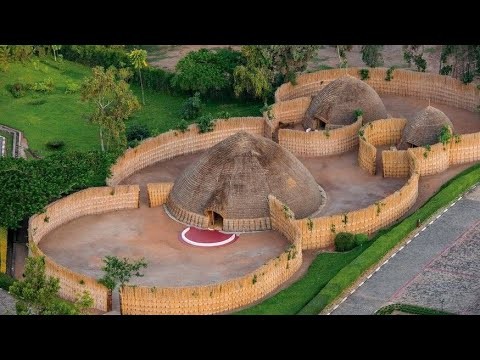


The National Museum of Rwanda, located in Huye District just 132 km from Kigali on the way to Nyungwe National Park, stands as the country’s largest and most renowned museum. Established in 1987, it proudly hosts one of the finest ethnographic collections in Africa. The museum features seven galleries that exhibit a wide range of historical, cultural, artistic, and archaeological artifacts, all supported by visual displays that offer deep insight into Rwandan heritage and traditions
Visitors can explore not only the pre-colonial era but also trace Rwanda’s cultural and societal evolution over time. This museum is a highly recommended stopover en route to Nyungwe Forest—not only as a break in the journey, but also as an enriching opportunity to experience the depth of Rwanda’s culture beyond its wildlife, cities, and natural parks.
Located in Nyanza District in Rwanda’s Southern Province, approximately 88 km from Kigali, the King’s Palace Museum offers an immersive journey into the legacy of Rwanda’s monarchy. The palace of King Mutara III Rudahigwa provides an insightful view into the traditional royal system that was abolished in the early 1960s due to colonial influence. Carefully reconstructed to reflect its 19th-century design, the palace is built entirely with traditional materials, offering visitors an authentic glimpse into the past.
One of the highlights of the site is the presence of the majestic long-horned royal cows, known as “Inyambo,” which symbolize nobility and cultural pride in Rwandan tradition. These cows, known for their elegance and calm demeanor, are often paraded in a ceremonial fashion, accompanied by traditional songs and poetry—something that never fails to impress visitors
Adjacent to the traditional structure stands the modern palace built in 1931, which served as King Mutara’s residence until his death in 1959. This building now showcases Rwanda’s history dating back to the 15th century. Just nearby, on Mwima Hill, you’ll also find the royal mausoleum, where King Mutara III, Queen Rosalie Gicanda, and King Kigeli IV Ndahindurwa are buried—making it a significant historical and cultural site in Rwanda.
Situated in Nyanza District, approximately 85 km from Kigali, the building that now serves as a museum was originally intended to be the palace of King Mutara III Rudahigwa. Its construction began in 1957 and was completed in 1959, but unfortunately, the King passed away before he could move in.
In May 2006, the structure was repurposed into the National Art Gallery, a role it maintained until May 2018, when a new Museum of Art was inaugurated at the former state house in Kanombe. Currently, the museum features a special exhibition centered around “Homegrown Solutions,” showcasing Rwanda’s innovative approaches to peacebuilding and economic recovery following the 1994 Genocide against the Tutsi.
Although its focus has shifted, the museum remains open to visitors and continues to display a rich collection of photographs portraying the everyday life and cultural history of various African communities, including Nigerians, Ugandans, and Rwandans.
The Kandt House Museum, formerly known as the Natural History Museum, is located just about one kilometer from downtown Kigali on KN 90 Street. The museum was renamed Kandt House Museum on December 17, 2017, in honor of Richard Kandt, the first German colonial resident in Rwanda.
Today, the museum is divided into three main sections. The first section offers a glimpse into Rwandan life before colonization, covering aspects of traditional society including its social structures, economic practices, and monarchy. The second and largest section focuses on the colonial period, specifically the era of German rule from 1884, starting with the Berlin Conference, through World War I, and ending in 1916. This part highlights the life and contributions of Richard Kandt in Rwanda.
The third section tells the story of Kigali—its origins, transformation during the colonial era, and development into Rwanda's capital city. As a unique feature carried over from its days as the Natural History Museum, visitors can still see a special outdoor exhibit of live snakes and a small crocodile (which measured about one meter in 2017). The museum also offers stunning panoramic views of Kigali and the nearby Shyorongi and Jari mountains, making it both an educational and scenic destination.